Hedgie, over at The Jackdaw’s Nest, has been writing about the Czech poet Miroslav Holub, who has long been one of my favourite poets.
I first read Holub in a Bloodaxe anthology and knew I had to read more, so I picked up a collection that covered much of his long writing career, "Poems: Before and After".
Andrew Motion wrote a good article on Holub for The Guardian.
Miroslav Holub is well worth checking out. You can read three of his poems at Hedgie's article I mentioned above. There are also other poems scattered around the Web.
I quote from a Holub piece in my poem Beyond the Blue, which is included in my The Clown of Natural Sorrow chapbook:
Beyond the Blue
Emptiness is greatest where man was rather than where he was not… Observing the stars, we experience an emptiness which is not theirs.
- Miroslav Holub
The sun pins the nylon sky, a backdrop
pressed blue behind the raised earth.
A pink church melts on the hill like a stick
of rock. The flag on its turret hangs still
and starched. Copperplate roofs scorch
the valley. Human shadows drain the piazza of light.
On a day like this, you crept within snatching distance
of the sun, unpinned it, and watched the sky
drift away like a sheet swept from a balcony line.
You floated out among the stars and night
for fourteen billion light years,
then returned to the church
and the roofs and the shadows, still searching
for the emptiness within, but found nothing
other than the rush of wind that now
drags at your sleeve.
Tuesday, December 27, 2005

Saturday, December 24, 2005

Friday, December 23, 2005
Football and Religion
A Glasgow Football Story
The burnt-out house of my childhood casts
shadows bent blue on the Ibrox Park gates.
Steak Pie Suppers cloud up the arctic air
with steam, which spirits through the old keyhole
like King Billy drove his white horse through
the eye of a needle on my bedroom wall
and flutes cracked windowglass to the city’s east.
My father removed Billy’s picture for one day
in the summer of seventy-three to welcome
the new family next door. I took Sean
to the balcony, played hanging over the side
for a dare, while the adults drank beer
like old school-friends. My mother called us
for Cremolafoam. I said, “Give the green cup
to Sean,” and was bundled to bed with
beatings to come. Sean left. Only now returns.
Notes: the "King Billy" of the poem refers to the Protestant King William of Orange. And in Glasgow, the traditionally Catholic team, Celtic, play in green and white colours. "Ibrox Park" is the home stadium of the traditionally Protestant team, Rangers.
Thursday, December 22, 2005
Lyric Flights and Pretentious Nonsense
I’ve always found it hard to write abstract philosophical or metaphysical poetry and make it convincing, let alone breathtaking. Often it’s hard to stop it falling on the wrong side of the line that separates a flight of lyricism from pretentious nonsense. Other poets don’t seem to have the difficulty. Wallace Stevens, for example:
She was the single artificer of the world
In which she sang. And when she sang, the sea
Whatever self it had, became the self
That was her song, for she was the maker. Then we
As we beheld her striding there alone,
Knew that there never was a world for her
Except the one she sang and, singing, made.
(from The Idea of Order at Key West, Selected Poems, Faber 1965)
or Don Paterson, who neatly shifts from abstract meditation into something far more earthy, so making the abstract bit work well:
In the meantime there is just this, which will do:
the qualified bliss of your once-more deferred
enlightenment, the plagal and imperfect cadences,
all those blessed suspensions of faith, as you lie
in the strong and small arms of your good and kind sister
with nothing much better or worse to look forward to
than your coffee, the paper, the dog on the bed.
(from The Alexandrian Library, part iii – Landing Light, Faber 2003)
I’ve been writing another sestina, the Metaphysical Sestina I posted the first stanza of a couple of months ago. It’s been hard going, and it’s full of passages like this (to be honest, this is probably the best bit):
…The plastic halo
he casts off, like a Frisbee, sends its soul
shooting back, a boomerang the earth
lifts and turns until the metaphysics
sings the path it takes. It’s not a trade
of plastic for angelic. More that heaven
floats the ground of being. More that heaven
forms the hole in all there is.
I want to be ambitious and challenge myself to write stuff I may not be capable of writing. As long as I end up writing it in spite of myself. But this one might defeat me.
Tuesday, December 20, 2005
More Launch Pics
You can see the three photos I posted to this blog from the recent HappenStance Press launch along with five others, including one of me looking as if I’m a naughty pupil sent to the headteacher’s study. It’s a jazzy little gallery.
Monday, December 19, 2005
The Others
Andrew wanted to know if the other poems I mention in the Liverpool Disappears Again article immediately below were available to read online. You can read them at the Guardian’s Forward Prize shortlists site, by scrolling down to the “best single poem” list.
Liverpool Disappears Again
I said I’d come back to comment on Paul Farley’s Forward Prize winner Liverpool Disappears for a Billionth of a Second .
Technically, all poems published anywhere in the UK in 2005 are eligible for this award. In practice, only those published in collections by mainstream publishers, or in the more important poetry magazines, or by well-known writers, stand a chance of winning. The judges each read 7,000 poems before deciding on the winners in various categories. 109 poems were nominated for Best Individual Poem, which the judges whittled down to a shortlist of 5 before picking their favourite.
I like the Liverpool poem. It’s witty and clever, it has more than one layer to it, and it connects to the experience of many people, whether that experience is real or imagined. It’s accessible without being trite, and it’s well written, but not overly academic. You can understand it straightaway on one level, although it sets you thinking deeper. It sticks in the brain and connects with the gut.
In many ways, as an advertisement for the Forward Prize and for poetry generally, it’s an ideal winner. It’s the kind of poem I could imagine drawing an intelligent non-reader of poetry to pick up a poetry book and read more. But it doesn’t represent a “dumbing down” of what poetry should be about. The poem is well crafted, well structured. Some might feel it could be stripped-down a bit, but the UK, it seems to me, has always been less insistent on that than our U.S. counterparts.
Was it the “best” poem on the shortlist? It wasn’t my favourite, although I did enjoy it.
I thought Sarah Maguire’s “Passages” was terrific, but at 135 lines, it’s a little long for exposure on the web or in publicity.
Stephen Knight’s “99 Poems” was intriguing. It’s an alphabetical list of made-up (I think!) poem-titles laid out alphabetically, as in an anthology index. What’s clever is the way you can look at each title and immediately tell what kind of poem it would likely be – from what era, what poetry school, what tone it’s going to have. Clever, funny, and original, but probably not one to appeal to the public. It’s a poem for poets and for existing avid readers of poetry.
Katherine Pierpoint’s “Buffalo Calf” must have been a strong contender. I quoted a section of it below, in my entry of 6 December. I’d class it as equal in quality to Paul Farley’s poem, but written in a completely different style. It lacks humour, but makes up for it in its intense lyricism.
Peter Scupham’s “Seventy Years a Showman” pulses with energy and drive. It’s packed full of names I’ve never heard of, along with italicised, invented quotes to portray a life in the fast lane. It’s not that easy to get into, but it’s compelling once you’re in there.
Why did Paul Farley’s poem have the edge over the rest? I’d guess it’s because it’s a good showpiece poem, for all the reasons outlined above. And probably that’s as good a reason as any to give it the winning ticket.
Saturday, December 17, 2005
The Haar
The Haar is pretty amazing, a web experience well worth having. Thanks to Martyn Clayton for drawing my attention to it.
The sea harp, the whistle thing, the lighthouse with the shipping forecast names – and weird music by Don Paterson amongst others. Way out.
The sea harp, the whistle thing, the lighthouse with the shipping forecast names – and weird music by Don Paterson amongst others. Way out.
Friday, December 16, 2005
Chapbook Launch Pics
I’ve managed to get hold of a few photos taken by Gerry Cambridge at the launch of my chapbook, along with the Winter Gifts anthology, two weeks ago,
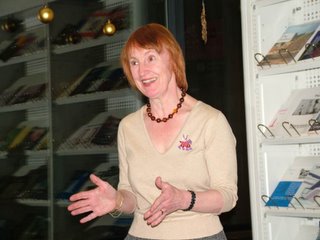
Helena Nelson, author of Unsuitable Poems and editor at HappenStance
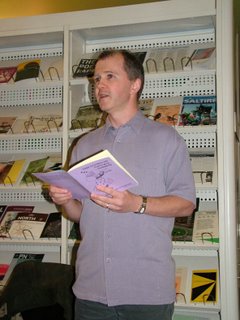
This is me with The Clown of Natural Sorrow
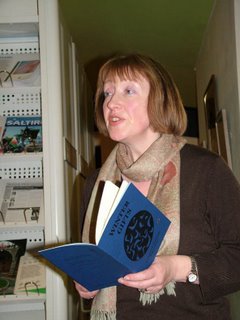
Eleanor Livingstone, author of The Last King of Fife and Artistic Director of StAnza, the biggest poetry festival in Scotland, held in St Andrews every March.

Helena Nelson, author of Unsuitable Poems and editor at HappenStance

This is me with The Clown of Natural Sorrow

Eleanor Livingstone, author of The Last King of Fife and Artistic Director of StAnza, the biggest poetry festival in Scotland, held in St Andrews every March.
Thursday, December 15, 2005
Best Poem of the Year?
Liverpool Disappears for a Billionth of a Second by Paul Farley won the Forward Prize for Best Poem published in the UK in 2005.
Any opinions? I'll post my opinion soon.
Any opinions? I'll post my opinion soon.
Wednesday, December 14, 2005
Tuesday, December 13, 2005
Rite of Passage
Monday, December 12, 2005
A Cloud in Trousers
Many poems can seem clever on first read. I read a few poems at an online poetry workshop (not PFFA) the other day and they were well written, rhythmic, even intelligent. But all four of them had the same major flaw in that they skirted around the surface of human emotion without really connecting to anything urgent. They played clever verbal games, but studiously avoided striking an emotional core.
I recognise the same tendency in some of my own poems as well – the ones I eventually grow dissatisfied with.
Then I read Larry’s thread in PFFA’s Voyages of Discovery Forum about Kenneth Koch and remembered this passage from Koch’s book Making Your Own Days:
“Putting inspiration to the best possible use is something one learns to do…Suppose the line comes to you,
I’m like a cloud in trousers
The least productive use of it, aside from simply forgetting it, is to throw it away in conversation… But supposing you recognise its possibilities for poetry; you write it down. One minimal use of the statement might be to make it part of a clever list:
Or like a night in gloves
A hurricane in a hat
Such a solution may seem superficial: one may want to be brought to something important – a strong emotion, a strong view of life. How could “a cloud in trousers” connect with anything like that? Mayakovsky finally used it as part of a long poem, of which one main theme is his strongly desiring, strongly suffering, wildly variable character - “I feel/My ‘I’/is too small./ Someone stubbornly bursts out of me,” he says of himself. And,
If you want –
I’ll rage on a raw meat
or, changing tones like the sky –
if you want –
I’ll be irreproachably gentle,
Not a man, but a cloud in trousers… "
(Kenneth Koch, Making Your Own Days, Touchstone Books, New York, 1998 pp. 87-88)
It seems to me there’s a lot to learn from that little example. The four poems I read at that online workshop all fell within Koch's "minimal use". Getting to the heart of the matter is more difficult, but a poem won't succeed unless it does that.
Friday, December 09, 2005
Superbowl: the Sestina
I love sestinas like this one, Superbowl! The Sestina, that subvert their own genre. And you don't need to know anything about American Football to get it.
Thursday, December 08, 2005
Tuesday, December 06, 2005
Elephant Architecture
The Forward Book of Poetry 2006 is (so far) the best of this series of annual anthologies I’ve read yet. The book tries to group together selections from the best collections and the best individual poems of the last year (i.e.2005).
I’ve been looking at the shortlisted individual poems. The prize for this category was won by Paul Farley’s poem Liverpool Disappears for a Billionth of a Second. It’s a good poem. I enjoyed it and thought it was very well structured and well written.
However I loved this passage from Katherine Pierpoint’s Buffalo Calf , originally published in Poetry London magazine, most of all. The calf lounges in the mud while first a cow then an elephant walk past:
A temple elephant too. The surprise of it – in town! – at church! –
for an elephant is its own cathedral.
Even thinking of an elephant
is architecture, elaborate; a plain hugeness at first disguising the
......subtleties there;
and there it stands and stands, and stands at the busy
......temple gate,
little as a lap-dog
against the mounting pyramid of stones,
the mass of carvings, the unending, up-ending sex,
the linked aeons of miracles.
I think she handles the elephant-as-architecture idea really well and the shifts of scale and of subject – from church, to cathedral, to lap-dog, to sex, to “linked aeons of miracles” – give the passage a dramatic fluidity of movement.
My favourite poem overall in this category is Sarah MacGuire’s Passages. It’s too long to quote in full and a partial quote wouldn’t do it justice. But it’s just terrific.
Sunday, December 04, 2005
P. C. Critics
I’m been thinking recently on whether it’s justifiable to use contemporary moral and social standards to criticise writers of the past for not living up to them.
C.S.Lewis, author of the Narnia books, has been attacked in the last month or two for being sexist, racist and for propagating Christian propaganda.
Because few of his female characters have lead parts and because their faults are shown up to greater effect than their male counterparts, Lewis is sexist. Indeed Philip Pullman has called him “monumentally disparaging of girls and women.”
Because the town of Calormene (in the novel “The Horse and his Boy”) is populated by dark-skinned, turban-wearing, garlic-eating people who worship a vulture god and live in a society beset by brutality and corruption, then Lewis is racist.
Because the story of the Narnia books is fairly obviously based on Christian theological ideas, he is propagating Christian propaganda.
I am uneasy when people make such attacks on a writer who wrote 50-60 years ago. I suspect people in 50-60 years time will be making similar attacks on writers of this oh-so-enlightened generation who might be considered politically correct today. And in any case, at the time Lewis wrote, how many Hollywood movies had women in lead roles, as opposed to hanging on the man-star’s arm? How many black movie stars were there (in positive, non-pigeonholed roles)? Is it fair to condemn Lewis when he lived in such a milieu?
I also feel that using terms like “sexist” and “racist” to describe someone who never actively advocated violence or hatred against either women or foreigners is unfair. Lewis perhaps did have feelings of unease towards people who were different from him, but that’s true of most people at some level. Today certain depictions of women and people of colour are considered offensive and unacceptable, but would have been absolutely normal in Lewis’s era. Lewis can be viewed more as a product of his time and class than as “racist” or “sexist”.
Finally the accusation that he propagated “religious propaganda” is, in my opinion, a gross misuse of the English language. Lewis was a Christian and was interested in using his narratives to get over ideas that were important to him. Isn’t that what writers have always done? I saw the movie “Troy” last year, which had a clear humanist agenda running through it. I didn’t see anyone protesting against humanist propaganda, and nor should they. Writers should be free to write what they want, just as an audience is free to agree or disagree with them. “Propaganda” is a loaded and inaccurate word.
So are p.c. critics so enlightened and wise today that they can confidently dismiss writers from the past according to contemporary standards? Or are they setting this generation up to be similarly judged by future ones, when today’s ideas will look every bit as half-witted as C.S. Lewis seems to some today?
Subscribe to:
Posts (Atom)